
Incoterms sea freight
The standard in international transport
Incoterms rules (International Commercial Terms) are an international standard on the rights and obligations of the buyer and seller in the international transport of goods, developed and published by the International Chamber of Commerce (ICC) the World Business Organization. These Incoterms are revised every 10 years.
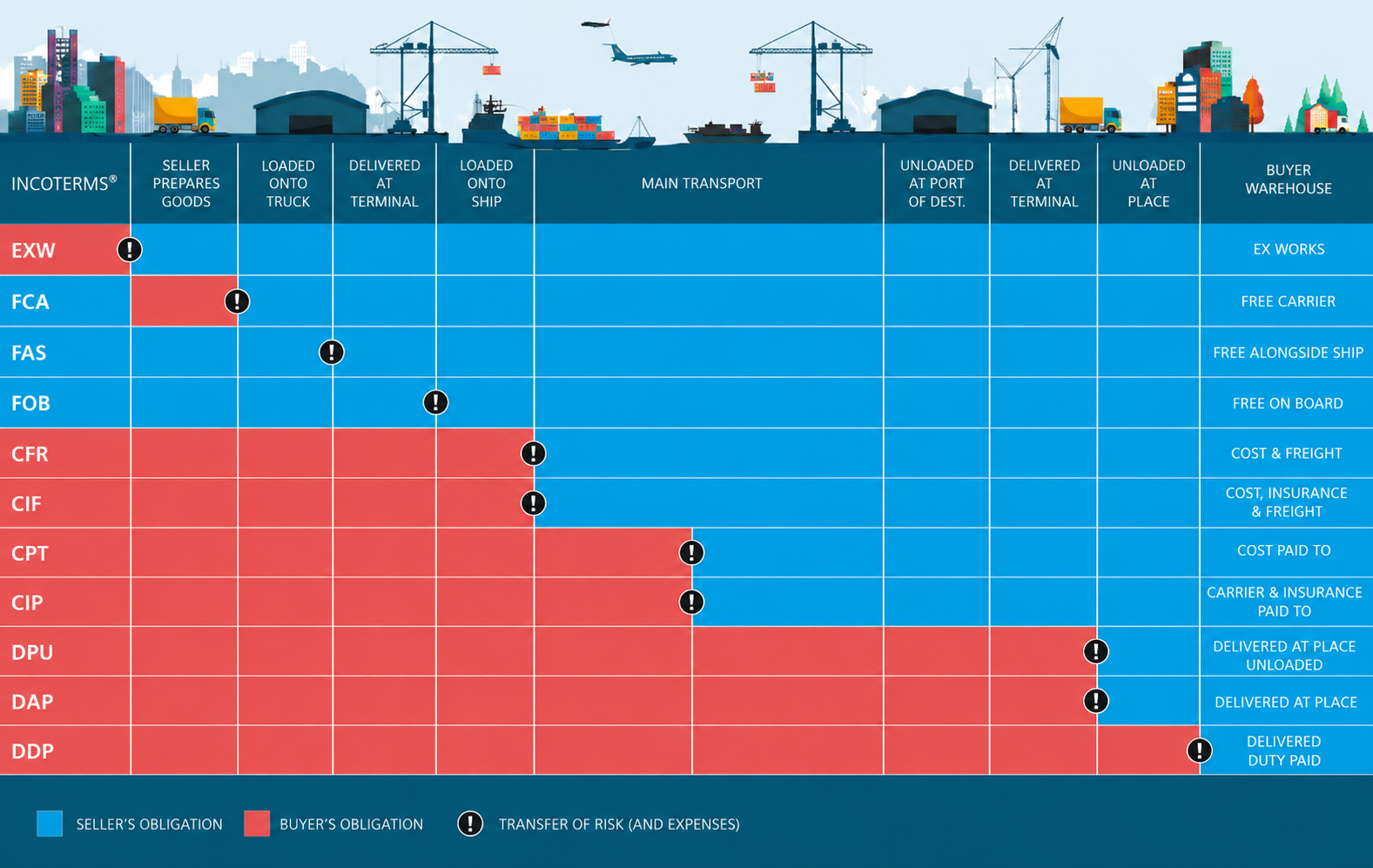
Incoterms® 2020: The complete guide for international transport
Are you an exporter or importer? Then you make agreements with your foreign business partner about the transport of the goods. By agreeing on Incoterms® you know which of the two is responsible for arranging the transport and who pays the costs of the transport. And who bears the transport risk. This is the risk of damage to, or loss of, the goods during transport. There are several Incoterms® rules with different obligations and responsibilities for the seller (exporter) and buyer (importer).
What importers and exporters really need to know about costs, responsibilities and risk
If you do business across the border, you must make agreements about transport. Not in general terms, but concrete ones. Who arranges what. Who pays what. And above all who is liable for damage or loss en route.
Incoterms® are the standard for this. If you record them well, you prevent discussion afterwards. If you record them wrongly, transport suddenly becomes expensive or legally complicated.
At The Freight Hero we not only arrange the transport, we also make sure that you understand what you are signing for. Below you will find a complete overview of all 11 Incoterms® 2020, with explanations from practice.
With effect from 1 January 2020, Incoterms® 2020 apply. Buyer and seller can choose from 11 Incoterms, divided into two categories:
Suitable for all modes of transport (including sea freight):
EXW - Ex Works
FCA - Free Carrier
CPT - Carriage Paid To
CIP - Carriage and Insurance Paid To
DAP - Delivered At Place
DPU - Delivered at Place Unloaded [Replaces the old DAT]
DDP - Delivered Duty Paid
Exclusively for transport by sea and inland waterways:
FAS - Free Alongside Ship
FOB - Free On Board
CFR - Cost and Freight
CIF - Cost, Insurance and Freight
Incoterms - Explanation
Incoterms govern the division of responsibilities, costs and risks between seller and buyer. Below you will find an explanation of the most commonly used terms.
EX WORKS (EXW)
The seller delivers the goods by making them available to the buyer at their warehouse, factory or workshop. This is the incoterm with the least responsibility for the seller. The seller only provides the goods, the invoice and minimal packaging. The buyer bears all costs and risks from the collection point to the final destination, including the loading of the goods on departure.
FREE CARRIER (FCA)
The seller provides the goods, the invoice and the export documents (export customs formalities). The seller hands over the goods to the carrier designated by the buyer at an agreed place. From that moment the costs and risks are for the buyer.
CARRIAGE PAID TO (CPT)
The seller pays for the transport of the goods to the named place of destination. The risk, however, already passes from seller to buyer as soon as the goods have been handed over to the first carrier. The buyer is therefore responsible for insurance during the transport.
CARRIAGE AND INSURANCE PAID TO (CIP)
The seller has the same obligations as with CPT (pays for transport), but with one important difference: the seller must also take out and pay for the transport insurance. Under Incoterms 2020, this insurance must have comprehensive cover (All Risk / Institute Cargo Clauses A).
DELIVERED AT PLACE UNLOADED (DPU)
Please note: This term replaces the old term DAT (Delivered At Terminal). The seller is responsible for the transport and the unloading of the goods at the agreed place of destination. The seller bears all risks up to the moment the goods are unloaded. This is the only Incoterm where the seller is obliged to unload.
DELIVERED AT PLACE (DAP)
The seller pays for transport to the named place of destination and bears all risks until the goods are ready to be unloaded. The buyer is responsible for paying import duties (clearance) and unloading the goods.
DELIVERED DUTY PAID (DDP)
With DDP the seller has maximum obligations. The seller arranges the transport up to the destination, bears all risks and pays all costs, including import duties and VAT. The seller delivers the goods "not unloaded" to the buyer.
Specific to sea freight:
FREE ALONGSIDE SHIP (FAS)
The seller provides the goods, invoice, packaging and the export formalities. Delivery takes place when the goods have been placed alongside the ship (for example on the quay or in a lighter) at the port of shipment. From that moment risk and costs are for the buyer.
FREE ON BOARD (FOB)
A commonly used term. The seller provides the goods, invoice, packaging, export permit and customs formalities. Delivery takes place (and the risk passes) as soon as the goods have been placed on board the ship at the port of shipment. From here the buyer takes on all risks and costs (such as the sea freight).
CFR (Cost and Freight)
The seller arranges and pays for the transport up to the destination port. However: the buyer bears the risk of loss or damage from the moment the goods are on board the ship in the port of departure.
CIF (Cost, Insurance and Freight)
Equal to CFR, but with an additional obligation for the seller: they must take out a sea transport insurance. Please note: under Incoterms 2020, for CIF (unlike CIP) basic cover (Institute Cargo Clauses C) is sufficient.
Need help
If you are unsure about the right Incoterm or want a competitive rate for a FOB or EXW shipment, we will think along with you.
The Freight Hero works transparently, practically and without surprises afterwards. Whichever Incoterm you choose.
More information can also be found in this short video of the Chamber of Commerce (KVK).