
Customs clearance
Declaring goods to Customs
When importing goods from a non-EU country, it is required to declare these goods to Customs. In most cases you must pay import duties, and sometimes other customs regulations apply as well. It is possible that additional import duties are imposed if your goods do not comply with safety standards, environmental regulations, economic aspects or health requirements.
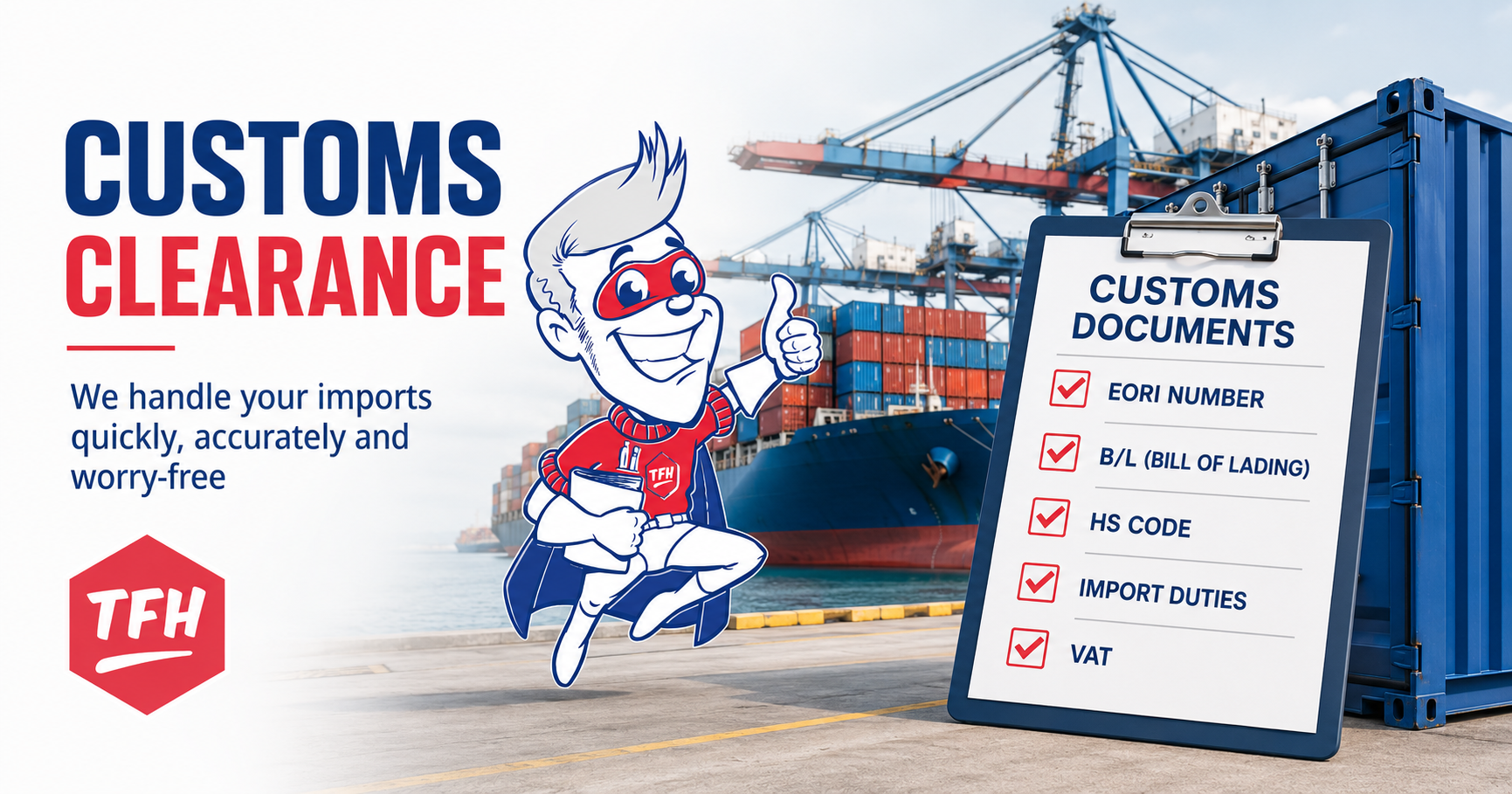
EORI number
An EORI number is required for customs declarations. The EORI number acts as an identification number for exchanging data with Customs. EORI stands for Economic Operators Registration and Identification, which refers to the registration and identification system for economic operators.
B/L – Bill of Lading
Various documents are required for the customs declaration. The first document is the original Bill of Lading (B/L). This document is received by The Freight Hero agent from your supplier in the port of loading. It confirms that the shipping line has received the goods for transport and will deliver them in the destination port to the designated recipient. The B/L is in fact proof of the contract of carriage (bill of lading) and represents the goods. It legally has the status of a security and is negotiable.
Express-Release B/L
With an Express-Release B/L no physical original B/L is drawn up and the recipient can dispose of the goods directly.
Telex-Release B/L
A Telex-Release B/L is a document that indicates the release of the goods stated on the B/L. It is issued by the supplier/manufacturer (shipper) to The Freight Hero agent in the port of loading. With a Telex-Release B/L you can dispose of the goods without needing the original B/L. The Telex-Release B/L can be sent by e-mail, so that the customs declaration can be made (more quickly) without sending the original B/L to customs by post.
How is the import levy determined?
The customs value of the goods to be imported determines the amount of tax to be paid. The customs value is based on the sale that took place immediately before the goods were brought into the customs territory of the European Union (EU), plus the costs of transport and the costs of any insurance taken out. The customs value of transport goods is the same in all EU countries. The turnover tax (VAT) or excise duties can, however, differ per EU country. Whether you import goods into the Netherlands, Belgium or Germany, the import duties to be paid are the same throughout the EU. All rates are listed in the user tariff. There is an explanation for the use of the user tariff.
How much are the import duties?
The amount of import duties depends on the specific products you import and the country of origin of the goods. If you want to know which import duty rate applies, you can consult the database of the Dutch customs or consult the Market Access Database of the European Union.
Goods code
A goods code is required for the customs declaration. This code is used by customs to determine whether the correct import tax and the correct VAT rate are applied, and to check whether an import permit is needed. The use of the same goods codes is standardised in all EU countries for the declaration of goods. You will find the goods code in the user tariff mentioned above, where you will also find:
- A description of the goods
- The duties and/or other taxes on import that you must pay
- Any special obligations you must take into account on import
- Goods codes can be consulted in the Market Access Database
HS Code
The World Customs Organization (WCO) has developed a 6-digit HS code for different categories of goods. To further specify certain goods that fall under the same HS code, the European Union has:
- Extended the HS code with 2 additional digits, in order to be able to link specific export measures to certain goods. This 8-digit code, also known as the Combined Nomenclature (CN code), is related to export.
- Added another 2 additional digits to the CN code in order to be able to link import measures, which ultimately resulted in the TARIC code.
This gives you the following codes:
- HS CODE: Basic world standard of 6 digits
- CN CODE: HS code of 8 digits, export related
- TARIC CODE: CN code of 10 digits, import and export rule related
Example: HS code 010.111
- Chapter 01: Live animals
- Heading 0101: Live animals - Horses, asses, mules and hinnies
- Heading 010111: Live animals - Horses, asses, mules and hinnies - Pure-bred
Customs declaration system
At The Freight Hero the import declaration runs fully automated and is completed within a few minutes. The declaration is submitted as soon as the goods have been delivered to the destination port, stating the exact location. In many cases the clearance can already be prepared before the delivery, so that the declaration can be sent directly on delivery.
Status: White
Non-risky declarations are processed directly and receive the status 'white'. Each declaration register is assessed on the basis of a selection profile. As soon as a declaration has been successfully processed and has received the status 'white', it is immediately made available to the importer and the transport of the goods can take place. You receive a 'Permission for Removal', with which the status of the goods is changed from customs goods to free goods. In addition, you receive a 'Completed Verification', on which any import duties and VAT amounts owed are stated.
Status: Orange
An import declaration can also receive the status 'orange'. In that case the declarant must provide the invoice and other relevant documents to customs. Customs will assess these documents to check whether the import declaration is correct and can, if necessary, launch a further investigation. If customs has remarks, they can correct the declaration. If everything is in order, you receive the 'Permission for Removal' and a 'Completed Verification', which means that the declaration has been handled and you gain disposal of the goods.
Status: Red
If customs decides that a physical inspection of the goods is needed, the declaration is marked as 'red'. Customs will then physically inspect the goods on site in the customs warehouse. After the physical inspection the goods are released, depending on the outcome of the inspection.
Want your customs clearance taken completely off your hands? The Freight Hero is the specialist that arranges it for you!