
Incoterms air freight
The Incoterms (International Commercial Terms) are internationally recognised rules that make clear what your rights and responsibilities are when buying or selling goods in international trade. These standards are issued by the International Chamber of Commerce (ICC), the organisation for businesses worldwide. To remain relevant, the Incoterms are revised every 10 years and adapted to the latest developments in international trade.
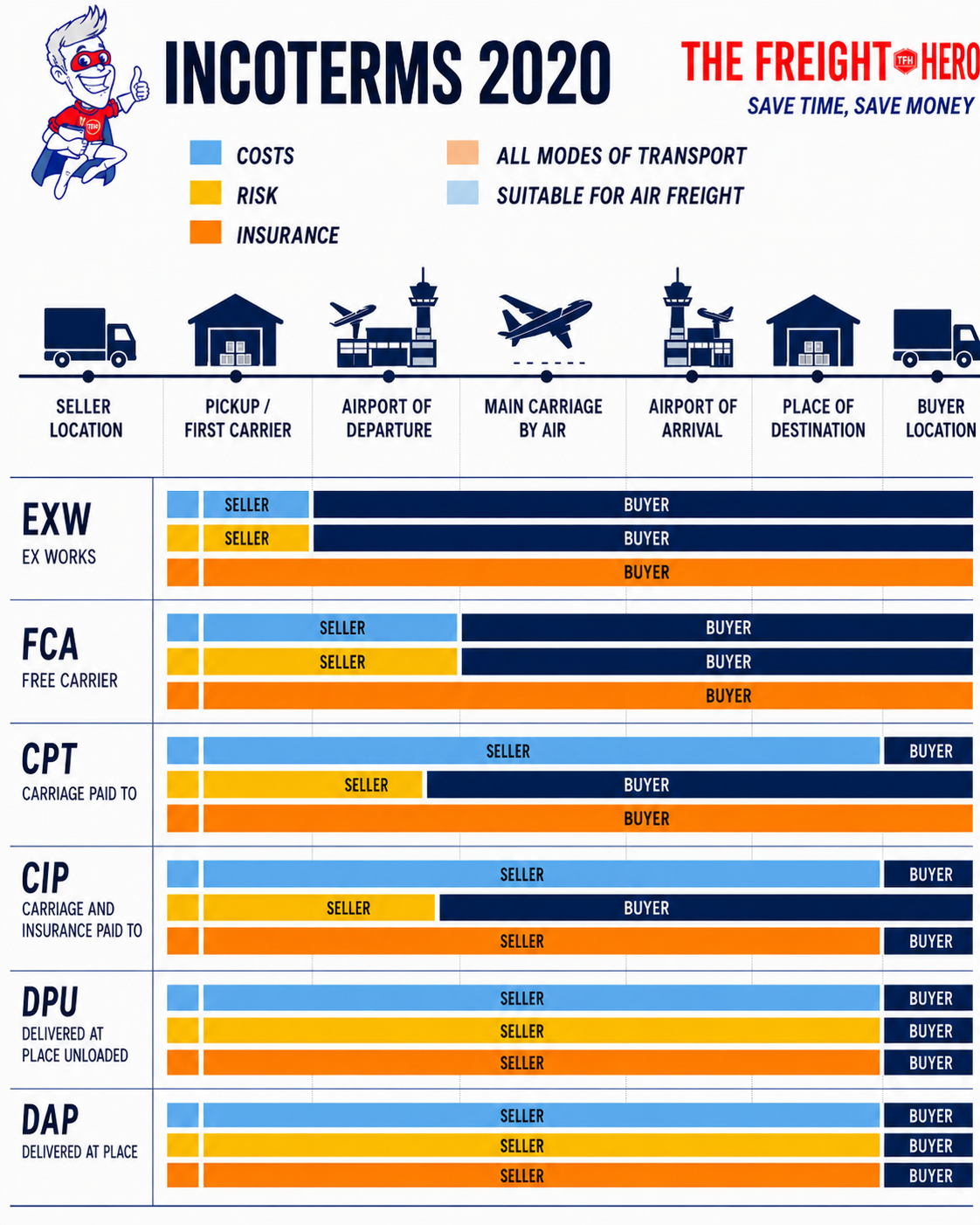
From 1 January 2011 you can choose from the 11 established Incoterms, as shown above.
Examples of Incoterms:
- EXW (Ex Works): You collect the goods from the seller and arrange everything further yourself.
- FCA (Free Carrier): The seller arranges transport up to the carrier, including documentation.
- CPT (Carriage Paid To): The seller pays for transport to an agreed destination.
- CIP (Carriage and Insurance Paid To): In addition to transport, the seller also pays for the insurance.
- DAT (Delivered At Terminal): The seller brings the goods to a specific terminal.
- DAP (Delivered At Place): The seller pays up to the agreed location, but you arrange the customs clearance.
- DDP (Delivered Duty Paid): Everything is arranged by the seller, including taxes and import duties.
Air freight import - FCA
With air freight import you usually use the FCA Incoterm, whereby the seller is responsible for the transport up to the airport (for example Schiphol). You have the choice here between delivery to the airport or directly to your door. Bear in mind that the seller is responsible for the export documentation.
Air freight import - FOB-Air
Although not formally recognised, the term FOB-Air is often used in air freight by sellers, buyers and the Tax Administration (Customs). It corresponds to the FOB term for sea transport. Here the seller pays the costs in the country of origin, while you as the buyer are responsible for the air freight costs, local costs at the place of destination, the further customs clearance and delivery to the door. After the customs clearance you also pay import duties and VAT.
Explanation of incoterms
Incoterms determine who is responsible for transport, insurance and customs handling, and when the risk of loss or damage passes. By choosing the right Incoterm you prevent surprises and ensure a smooth transport process. We explain various commonly used Incoterms further below:
Ex Works
With the Ex Works Incoterm the seller delivers the goods at their factory, warehouse or workshop. The seller's responsibility ends at that moment, because they only arrange the minimal packaging and the invoice. From the collection point both the risk and the organisation of the transport lie entirely with the buyer.
FCA Free Carrier
With the FCA Incoterm the seller takes care of all the necessary documentation, such as export permits, invoices and customs formalities. In addition, the seller takes care of the packaging and bears the costs until the goods are handed over to the first carrier. From that point the buyer takes on the risk and the costs.
Carriage Paid To (CPT)
Under the CPT Incoterm the seller is responsible for the transport costs up to the agreed location. As soon as the goods have been handed over to the first carrier, the risks pass to the buyer. In the Netherlands this arrangement is often equated with ENF (Ex Works).
Carriage and Insurance Paid To (CIP)
With CIP the seller takes on the same responsibilities as with CPT, but with an additional obligation. The seller must take out a freight insurance to cover the risks during transport. This way the goods are better protected during the journey.
Delivered at Terminal (DAT)
The DAT Incoterm was specially developed to emphasise deliveries at container terminals, storage spaces or ports. The seller arranges and pays for the transport up to the terminal and also bears the risk during the journey. This Incoterm can be applied to all forms of transport and replaces the earlier DEQ arrangement.
Delivered At Place (DAP)
With DAP the seller takes care of the transport up to an agreed location. The costs and risks up to that point lie with the seller, but the clearance costs on arrival are for the buyer. DAP is applicable for all types of transport and offers a flexible solution.
Delivered Duty Paid (DDP)
With DDP the seller has the most obligations. They are responsible for the delivery of the goods up to the agreed destination, including all import duties and taxes. The buyer only has to receive the goods, which makes this Incoterm very user-friendly.
Free Alongside Ship (FAS)
Under FAS the seller ensures that the goods are delivered up to alongside the ship, including the packaging costs and export permits. After this point the buyer is responsible for further transport costs and risks. This Incoterm is mainly used in sea transport.
Free on Board (FOB)
The FOB Incoterm requires the seller to deliver the goods on board the ship, including all costs up to that point. From the moment the goods are safely on board, the buyer bears all risks and costs. According to the 2010 rules, the delivery is only confirmed when the stowage certificate has been issued.
CFR (CNF) Cost and Freight
With CFR the seller takes on the costs for transport and freight up to the port of destination. The risk, however, already passes to the buyer as soon as the goods pass the ship's rail in the port of shipment. This makes the buyer responsible for damage or loss during the rest of the journey.
CIF Cost, Insurance and Freight
The CIF Incoterm closely resembles CFR, but adds an additional obligation: the seller must take out insurance for the goods during the sea freight. This term is used exclusively in sea transport and inland shipping and offers extra certainty for the buyer.
With a good understanding of the right Incoterms for air freight you prevent ambiguities and unexpected costs. Let The Freight Hero help you arrange your international transport smoothly and trouble-free!