
The Most Important Container Terminals in the Port of Rotterdam
February 2, 2025
The Port of Rotterdam is the largest port area in Europe. Its size is due to its location on the Rhine River, giving access to a hinterland of approximately 460 million people. In addition to inland shipping, a large part of the cargo is transported by road and, to a lesser extent, by rail. The port hosts major container terminals, each with its own owners and operators.
Waalhaven
As early as 1907, the Rotterdam city council approved the construction of the Waalhaven, and excavations began largely by hand. Until the 1990s, Waalhaven served mainly as a transshipment port for bulk and container goods. The area has since evolved into Rotterdam’s economic logistics center, linking the city, port, and hinterland.
First Maasvlakte
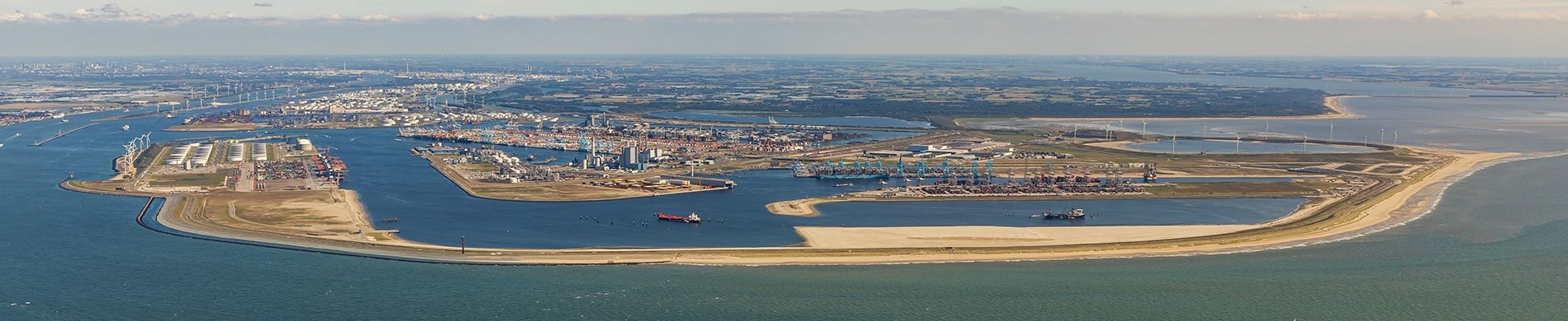
In the 1960s, Rotterdam developed the Maasvlakte, now referred to as the First Maasvlakte, to distinguish it from the later Second Maasvlakte. Located directly on the North Sea, 40 km from the city, the first container ships arrived in 1973. The Maasvlakte was created by constructing a ring dike and pumping sand from the North Sea into it.
Second Maasvlakte
Maasvlakte 2 is the expansion project of the Port of Rotterdam. Construction began in 2008 to the west of the original Maasvlakte. With this 2,000-hectare extension into the sea, the Port of Rotterdam increased in size by 20%. It became operational in 2013. The total port area now spans 12,000 hectares.
ECT Delta Terminal
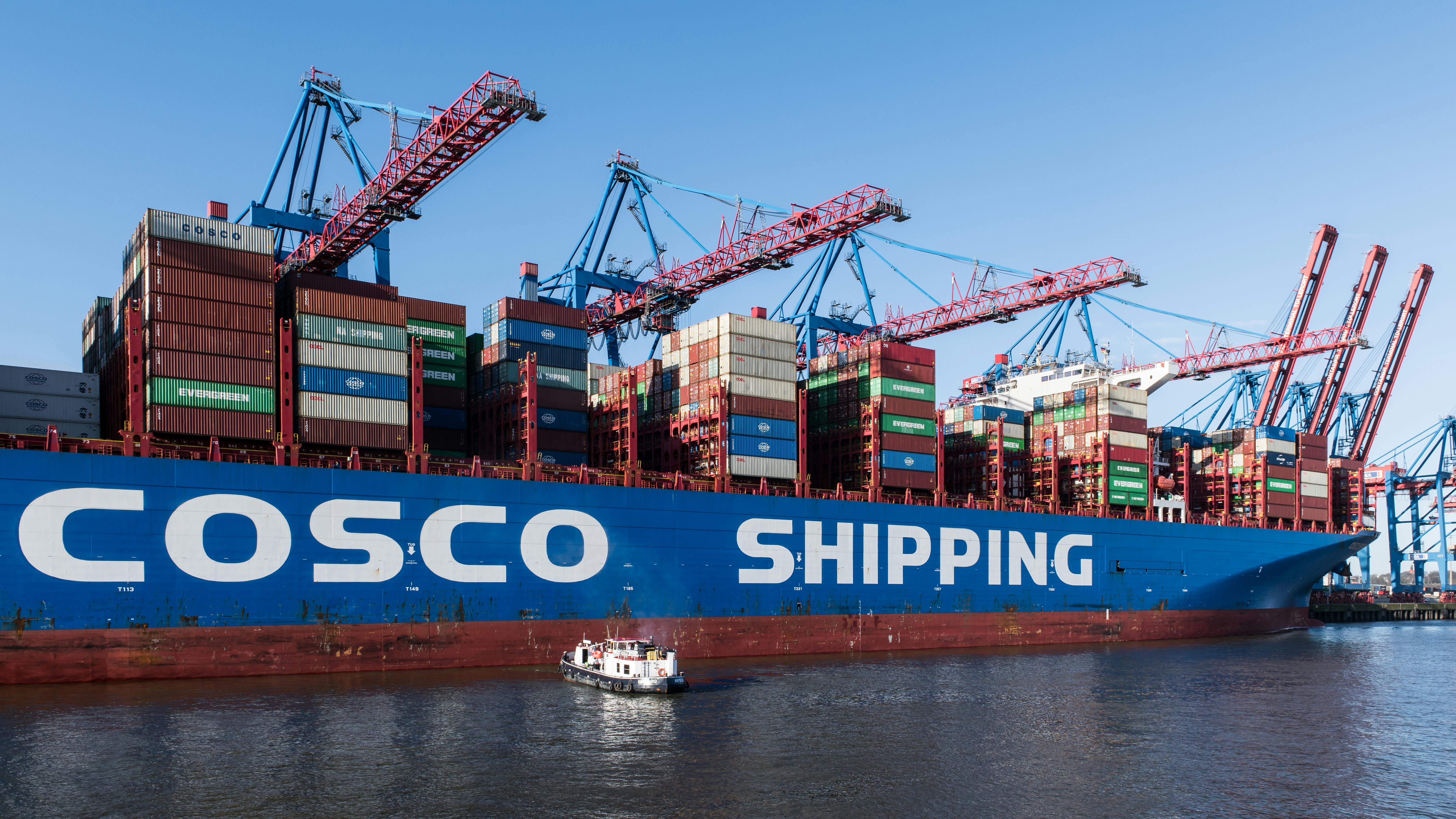
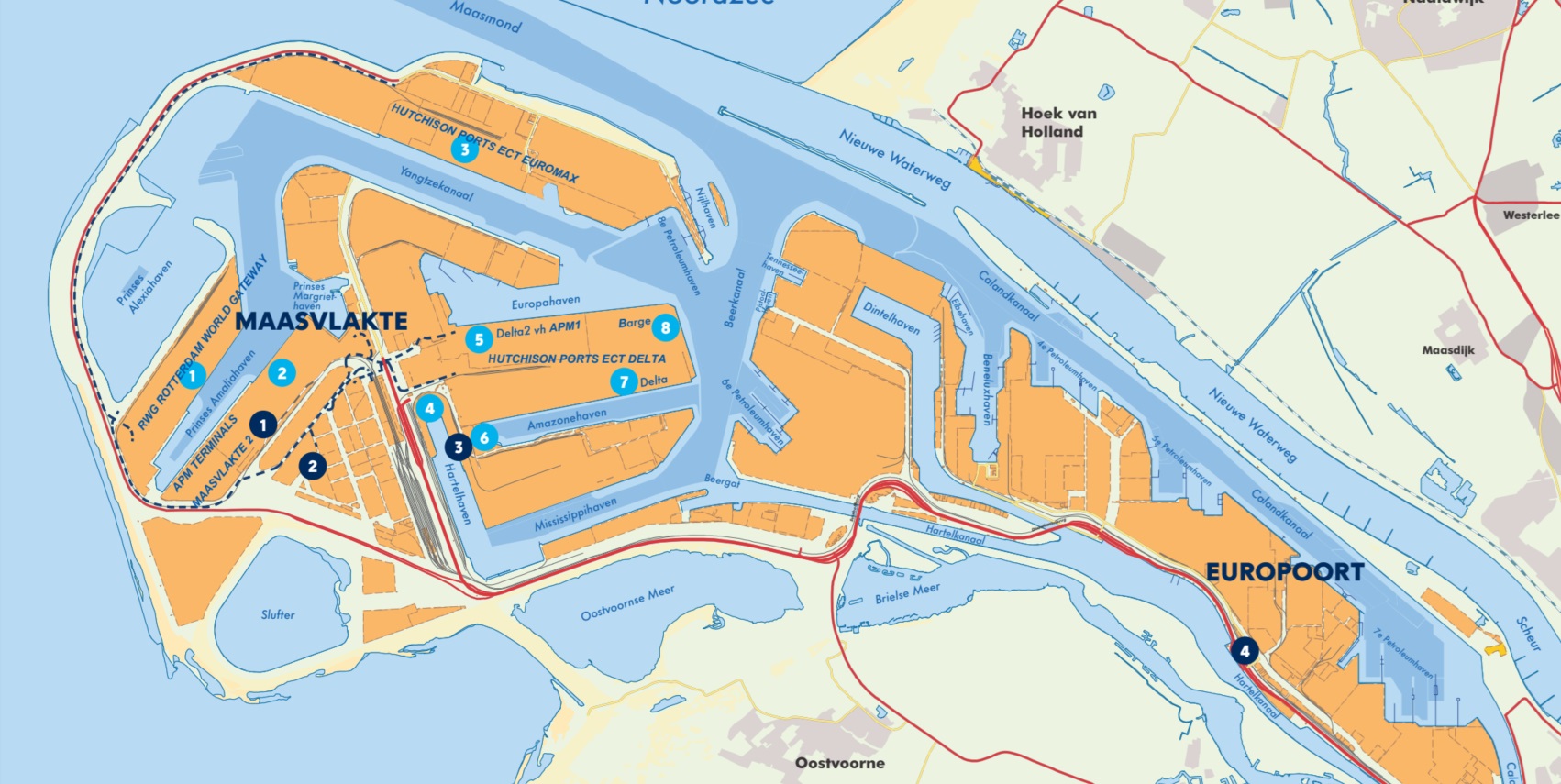
Located on the First Maasvlakte, this terminal can accommodate the world’s largest container ships 24/7, with no restrictions due to tides or locks. The water depth in front of the quay is 16.65 meters. Ships can dock within one hour of entering the harbor. Many shipping lines select ECT Delta as their first port of call in Europe.
Owned by: Hutchison Ports, which operates 53 ports in 24 countries.
ECT Euromax Terminal
Also owned by Hutchison Ports, Euromax is one of the world’s most modern and environmentally friendly terminals. Located on the Second Maasvlakte, right on the North Sea, it is designed for fast, safe, and efficient handling of the largest container ships.
Hutchison Delta II (Delta 2)
Since 2021, Delta 2 has been part of Hutchison Ports. Initially launched in 2000 as Maersk Delta, it was renamed APM Terminals Rotterdam (APM 1) in 2002.
Rotterdam World Gateway (RWG)
Located on the Second Maasvlakte, RWG is a container terminal operated by an international consortium including four global shipping companies:
MOL
Hyundai Merchant Marine (HMM)
CMA CGM
DP World (Dubai Ports) – 30% stake
CMA CGM – 10%
MOL, HMM – 20% each
APM Terminals Maasvlakte II
Established in 2015, APM Maasvlakte II is the most modern terminal in the port and is operated by APM Terminals, a subsidiary of A.P. Moller-Maersk. A recent agreement with the Port of Rotterdam will expand the terminal by 47.5 hectares and add a 1 km long deep-sea quay by 2026. This will increase capacity by 2 million TEU per year. The terminal focuses on automation, sustainability, and handling of the world’s largest ships.
QTerminals Kramer Rotterdam
Founded in 1963 as a repair shop, Kramer Rotterdam has evolved into a specialist in container depots and empty container handling across multiple sites in the port. Its transshipment activities focus on the Maasvlakte. The Delta Container Services joint venture with ECT handles both full and empty containers. In 2023, QTerminals, a Qatari state-owned company, acquired a 90% majority stake.